

Introduction
You have the skills. You have the sales wins on your resume. But if recruiters cannot find you online, none of that matters. In 2026, the modern job hunt starts in one place.
LinkedIn is no longer just a simple networking site. It is the engine for professional hiring today. Did you know that 6 people get hired through LinkedIn every minute? That is over 8,600 people landing jobs every single day.
For sales professionals, the platform is extra important. Many companies now use the linkedin in job search process to find candidates before they even post a public job opening.
But here is the hard truth. A messy or incomplete profile can actually hurt you. It can hide your application from the recruiters you want to meet. Without the right keywords in your headline and summary, you simply won’t show up in their searches.
This is why having a profile is not enough. You need a real strategy to turn your profile into a lead generation tool. You need to make linkedin job alerts work for you. And you should understand how linkedin api job search tools can give you an extra edge over other candidates.
That is exactly what this guide is for. We will walk through the exact steps to optimize your profile for your job search linkedin goals in 2026.
Ready to make your profile work for you?
Read More
Why Your LinkedIn Profile Is Your #1 Sales Tool in 2026
Think about how you find new leads at work. You search, you look at profiles, you decide who is worth a conversation. Recruiters do the exact same thing with your LinkedIn profile.
In 2026, recruiters rely on LinkedIn more than any other tool to find and vet candidates. According to recent LinkedIn hiring statistics for 2026, the platform is the primary source for professional recruitment. Many hiring managers start their search here before they even write a job description. This means your profile is a lead that you are pitching to decision makers every single day.
First impressions happen fast. Recruiters decide about you in a few seconds based on two things. Your headline and your profile photo. A weak headline with just your job title gets skipped. A strong headline with keywords like "job search linkedin" and your target role makes them stop scrolling.
An optimized profile does more than just get views. It generates inbound recruiter messages. When your skills, experience, and headline match what recruiters search for, they reach out to you first. You become a passive candidate who gets offers without applying.
This is exactly why you need to treat your profile like a landing page. It is a 24/7 sales tool that works for you. If you want to see how other sales professionals build their profiles, check out our guide on top job search sites for sales professionals in 2026.
Ready to turn your profile into a recruiter magnet? Browse Articles for more strategies to make your LinkedIn profile work for you.
Crafting a Compelling Headline and About Section
Your headline is the first thing people see in any job search linkedin activity. It appears in search results, in messages, and next to every comment you make. So you cannot afford to leave it as the boring default.
Here is a hard truth. Your LinkedIn headline has only 220 characters in 2026, and only about 70 characters show up on mobile screens. That means you have a very small window to grab attention. The best headlines follow a simple formula: Role + Who You Help + Proof or Keyword.
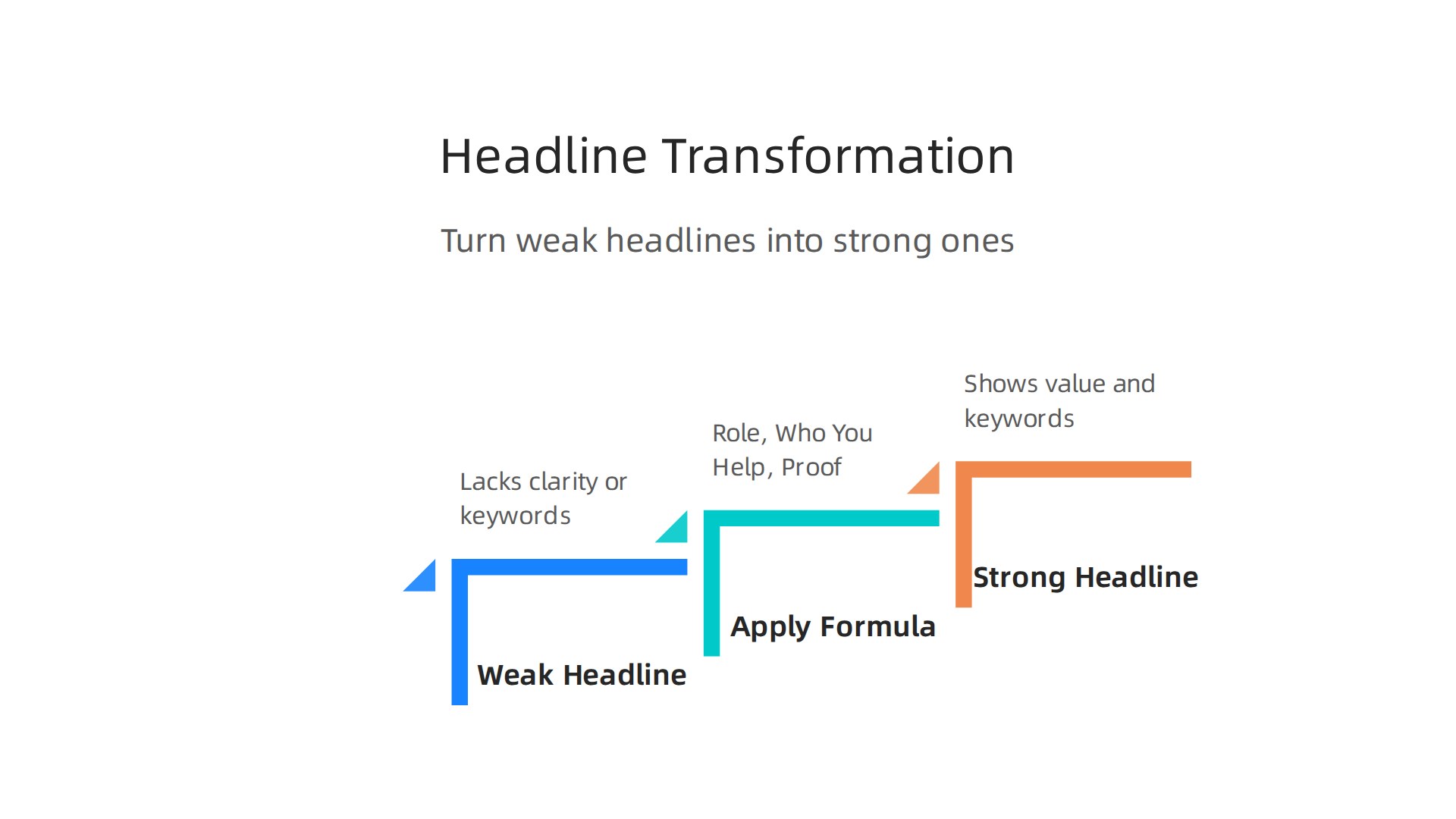
Skip the default "Job Title at Company" and lead with value instead.
Let me show you what this looks like in practice.
| Weak Headline | Strong Headline |
|---|---|
| Sales Manager at ABC Corp | Inside Sales Manager helping B2B teams close 30% more deals |
| Account Executive at XYZ Inc | Senior Account Executive serving mid market healthcare clients |
Notice how the strong version uses keywords like "Inside Sales Manager" and "SaaS Sales Leader." These are the exact phrases recruiters type into search bars. Research shows that the right headline can open doors and enhance your professional branding, so take the 10 minutes to rewrite yours today.
Now let us talk about your About section. Most people treat this as a biography. They list their past jobs and duties in boring paragraphs. That is a huge missed opportunity.
Think of your About section as a results-driven story. You want to hook the reader in the first sentence. Then you explain the problem you solve, how you solve it, and what results you deliver. End with a clear call to action like "Message me if you are hiring for a regional sales director role."
Use linkedin in job search keywords throughout this section naturally. Mention your target role, industry, and key skills two or three times. This helps you appear in more recruiter searches without sounding spammy. For more strategies on using search tools effectively, read our guide on career advice in UK 2026 how to land sales jobs fast.
A quick tip. Set up linkedin job alerts for your target roles. This way you see new opportunities as soon as they appear, and you can tailor your profile to match what hiring managers are looking for right now.
Your headline and About section work together as a one-two punch. When both are optimized, recruiters find you faster, read more, and reach out more often. That is the power of a well crafted job search linkedin profile.
Ready to take the next step? Browse Articles for more practical tips on landing your dream sales role.
Highlighting Your Sales Experience and Achievements
Now that your headline and About section grab attention, it is time to prove you can deliver. The experience section on your job search linkedin profile should focus on outcomes, not daily tasks.
Hiring managers already know what a sales rep does. They want to know what you did differently. Did you crush quota? Did you open new territory? Did you consistently bring in pipeline?
Here is a simple way to think about it. Every bullet point under a job should start with a strong action verb followed by a number.
Look at the difference.
Weak
- Managed accounts in the Northeast region
- Responsible for cold calling
- Helped close deals with existing clients
Strong
- Exceeded annual quota by 25% in 2025, generating $1.2M in new revenue
- Built a pipeline worth $800K through targeted cold outreach in the healthcare sector
- Expanded wallet share across 15 existing accounts, increasing average contract value by 18%
See how the strong version signals impact instantly. Recruiters scan profiles fast. Numbers stop the scroll. When you use metrics like revenue, quota attainment, and pipeline value, you tell a story that words alone cannot.
Now here is another important piece. Tying your results to the business. Do not just say you closed deals. Say you closed $2M in new business that saved the company from a revenue gap. That kind of framing makes you look like a strategic asset, not just a salesperson.
Also weave in relevant keywords from job descriptions. If target roles ask for "B2B enterprise sales," "SaaS closing," or "consultative selling," include those exact phrases in your bullet points. This helps with linkedin in job search visibility and shows you speak the language.
For more on how to tailor your profile for specific roles, check out our guide on top job search sites for sales professionals in 2026.
If you are early in your career with fewer numbers, that is okay. Focus on percentage improvements, time saved, or deals supported. Every role has impact to highlight.
Your experience section is where the job search linkedin algorithm matches you to recruiter searches. Make every bullet count.
Browse Articles for more practical tips on landing your dream sales role.
Leveraging Recommendations and Endorsements
Your experience section proves you can sell. But what happens when someone else says the same thing? That is where recommendations and endorsements come in. They act like a third party vouching for you. And they matter more than you might think.
Think about it this way. Anyone can write their own bullet points. But when a former manager or client writes a recommendation on your job search linkedin profile, it carries real weight. Recruiters see that as honest proof of your impact.
Here is the thing. Not all recommendations are equal. A generic "John is a great salesperson" does almost nothing. You want specific, detailed recommendations that mention numbers, skills, and results. For example, a recommendation that says "Sarah exceeded quota by 30% in her first year and built a $500K pipeline" tells a recruiter exactly what they need to know.
So how do you get those strong recommendations? Ask for them. Reach out to a former manager, a client you helped, or a colleague who saw your work. Make it easy for them. Give them a few specific points you would love for them to mention, like a big deal you closed or a territory you opened. The LinkedIn recommendation examples from Valley show simple frameworks you can share with people writing for you.
Now let us talk about endorsements. These are the skill badges on your profile. They might seem small, but they help your linkedin in job search visibility. When people endorse you for skills like "B2B sales," "cold calling," or "negotiation," it signals to LinkedIn’s algorithm that you know what you are doing. The more endorsements you have for the right skills, the better your profile ranks in recruiter searches.
That is backed up by research. One guide on LinkedIn skill endorsements explains that endorsements carry algorithmic weight. And knowing which skills recruiters actually search for in 2026, like the top 15 in-demand skills, helps you choose the right ones to feature.
A quick tip. Turn on linkedin job alerts so you see roles as they get posted. Then use your recommendations and endorsements to stand out in the application pool.
Both recommendations and endorsements take a little effort upfront. But they make your profile more complete and more credible. And in a competitive market, that extra proof can be the difference between a recruiter reaching out or scrolling past.
Want more tips to level up your profile? Browse Articles for guides on standing out in sales interviews and landing your next role fast.
Using Keywords to Get Found by Recruiters
You have strong recommendations and endorsements on your job search linkedin profile. But there is one more thing that decides whether a recruiter even sees your profile. Keywords.
Recruiters use LinkedIn’s search box every day. They type in terms like "B2B sales rep," "SaaS account executive," or "medical device specialist." If your profile does not contain those exact words, you do not show up. It is that simple.
So how do you pick the right keywords? Start by looking at real job descriptions. Find five to ten roles you want. Copy the job titles, the required skills, and the daily tasks. The words that appear over and over are your keywords. For example, if every posting asks for "cold calling," "pipeline management," and "closed won revenue," those go straight into your profile.
According to a detailed guide on LinkedIn profile optimization, the most important spots for keywords are your headline, your About section (especially the first 300 characters), your current job title, and your experience section. Do not stuff them in everywhere. Use them naturally, the same way you would describe your work to a colleague.
Here is where to place them:
- Headline – Your headline has 220 characters. Use it to blend your job title with a key skill. Example: "Enterprise Sales Rep | B2B SaaS | Cold Calling & Pipeline Management."
- About section – The first two lines matter most. Open with your top keywords and your biggest result. Then expand with related terms.
- Skills section – This is where the top 15 in-demand skills for 2026 can guide you. Choose skills that match both your experience and what recruiters actually search for.
- Experience section – Use keywords in your bullet points. Instead of "helped grow sales," write "built $500K pipeline through cold outreach and closing."
Avoid keyword stuffing. If your profile reads like a robot wrote it, recruiters will click away. Use each keyword once or twice in natural sentences.
One more trick. Use linkedin job alerts to see which terms employers favor. As new roles pop up, notice the language they use. Update your profile to match.
For a deeper look at how to find the best opportunities, check out our guide on the top job search sites for sales professionals. It walks you through where to hunt for roles after you optimize your profile.
Taking the time to match your linkedin in job search keywords to what employers type is a small effort that pays off big. Your profile gets seen more. You get contacted first. And you skip the line of generic applicants.
Ready to keep learning? Browse Articles for more tips on landing your next sales role faster.
Optimizing Your Profile for Remote Sales Opportunities
Maybe remote work is your goal. In 2026, more sales roles are fully remote than ever. But here is the thing. Recruiters cannot read your mind. Your job search linkedin profile must scream "I want remote work" in every section that matters.
Start with your location settings. Change your location to "Remote" or add it next to your city. For example, "San Francisco Bay Area (Remote)" or just "Remote, United States." Recruiters filter profiles by location every single day. If your location says only a city name, you might not show up for remote searches.
Your headline is the second place to act. Add the word "Remote" or "Virtual" right in it. Something like "Remote Enterprise Sales Rep | B2B SaaS | Cold Calling & Pipeline Management." According to a detailed guide on optimizing your LinkedIn for remote jobs, headline formulas that include "remote" perform much better with recruiters who are hiring for distributed teams.
Now look at your experience section. If you have worked remotely before, call it out. Do not hide it. Use bullet points like these:
- "Managed virtual sales pipeline across four time zones"
- "Closed $400K in revenue while working fully remote"
- "Collaborated with remote cross functional teams using Slack and Zoom"
- "Self starter who independently sourced and closed 15 new accounts per quarter"
These phrases prove you can handle remote work. Recruiters want to see self management skills. Words like "self starter," "independently," "autonomously," and "owned" are gold.
Do not forget to use keywords like "remote," "virtual," and "work from home" in your About section and Skills section too. One or two uses in natural sentences is enough.
For a deeper look at finding real remote sales roles, check out our guide on how to land legitimate part time remote sales jobs in 2026. It gives you specific platforms and strategies that work right now.
Taking these small steps makes your linkedin in job search profile irresistible to companies that hire remote. You move from "maybe open to remote" to "ready and proven for remote."
Want more help getting your profile right? Read More for guides that walk you through each step of landing your next sales role.
Engaging with Content to Boost Visibility
So your profile looks great now. But here is the thing. A perfect profile that just sits there will not get you noticed. In 2026, the job search linkedin game is all about activity. You have to show up and engage. That is how recruiters find you.
Start by sharing your thoughts on industry news or sales trends. Post a short update with your take. It does not have to be long. A few sentences that show you understand the market are enough. Then comment on posts from leaders and companies you admire. Add real value. Do not just say “Great post.” Say something like “I have seen the same shift in enterprise sales. Automation helps but relationships still close the deal.” That kind of comment makes people click your name.
Another powerful move is to publish short articles on LinkedIn. Write about a challenge you solved or a tip that helped you hit quota. This signals expertise and keeps you top of mind. According to a guide on turning your LinkedIn profile into a B2B lead machine, regular content creation helps you win high-value opportunities.
Consistency matters a lot. Plan to post or comment at least twice a week. Set a reminder. Use linkedin job alerts to find relevant discussions in your niche. When you engage regularly, your profile views go up. Recruiters start to see you as an expert. That is how a strong linkedin in job search strategy works.
Need more ideas on staying active and landing roles? Our guide on how a careers advisor helps you land sales jobs faster in 2026 covers expert networking and engagement tactics that work.
Start engaging today and browse our articles for more ways to stand out in your job search.
Common Mistakes to Avoid in Your LinkedIn Profile
You have done a great job engaging with content and staying active. But there is one piece that can still hold you back. Your profile itself. Even with great activity, a few common mistakes can turn recruiters away. Let us look at three big ones.
Incomplete profile sections lower your credibility. Recruiters want to see a full picture. If your experience section has gaps or you skip adding your education and certifications, it looks like you do not care. Fill out every section. Add a clear summary, list your job responsibilities, and include any sales training you have completed. A half-done profile tells recruiters you are not serious about your job search linkedin efforts.
Generic headlines and summaries fail to stand out. Your headline is the first thing people see. Do not just put "Sales Professional." That is boring and says nothing. Instead, use something specific like "Enterprise Sales Rep | Helping SaaS Companies Grow Revenue 20%+ Year Over Year." Your summary should tell a quick story about what you do and what results you deliver. This is a key part of your linkedin in job search strategy. When your headline and summary are generic, recruiters scroll right past you.
Lack of recommendations and poor photo selection hurt views. A professional photo makes you look trustworthy. Avoid selfies or group shots. Use a plain background and a friendly smile. Also ask past managers or colleagues to write a short recommendation. Even two or three strong recommendations can boost your credibility a lot. Some job seekers rely on linkedin api job search tools to automate applications, but if your profile lacks social proof, those applications will not convert.
Double check your profile today. Fix these mistakes and you will see more recruiter messages and more interviews. For more help on where to find sales roles and how to apply, check out our guide on top job search sites for sales professionals in 2026.
Make your profile work for you. Read More for more sales career tips.
Summary
This guide explains how sales professionals can turn their LinkedIn profile into a recruiter magnet in 2026 by treating it like a 24/7 sales landing page. It covers why LinkedIn is the primary hiring tool today and then walks through concrete steps: writing a value-driven headline, crafting an About section that leads with results, and using experience bullets that include numbers and business impact. The article also explains how to get meaningful recommendations and endorsements, choose and place the right keywords, and optimize settings and copy for remote roles. You’ll learn simple posting and engagement habits that increase visibility, plus common profile mistakes to fix immediately. Implementing these tactics helps you show up in recruiter searches, attract inbound messages, and move from applying to being recruited.