

Introduction
You have probably seen them in a hospital hallway. A person gently pushing a bed or a wheelchair, moving a patient from one room to another.

That person is a patient transporter. And the truth is, hospitals could not run without them.
Patient transporters play a vital role in healthcare facilities by ensuring the safe and efficient movement of patients between different areas. They help people get where they need to go for care, whether that is an X-ray, an operating room, or a discharge exit. Transporters position patients correctly, secure safety straps and equipment, navigate busy hallways and elevators, and monitor comfort along the way.
This role offers an accessible entry point into the healthcare industry. You do not need a college degree or years of experience to start. Many hospitals are hiring immediately for patient transporter jobs. It is a way to get your foot in the door, learn how a hospital works, and interact with patients every day. Plus, the role can lead to bigger things. Many people use it as a stepping stone to PCT jobs, nursing, or other clinical careers.
This guide covers everything you need to know. We will walk through the duties, the skills you need, certification options, salary expectations, how to find jobs hiring immediately, and how to grow from here.
Ready to explore one of the most rewarding entry level roles in healthcare? Let us get started.
What Does a Patient Transporter Do?
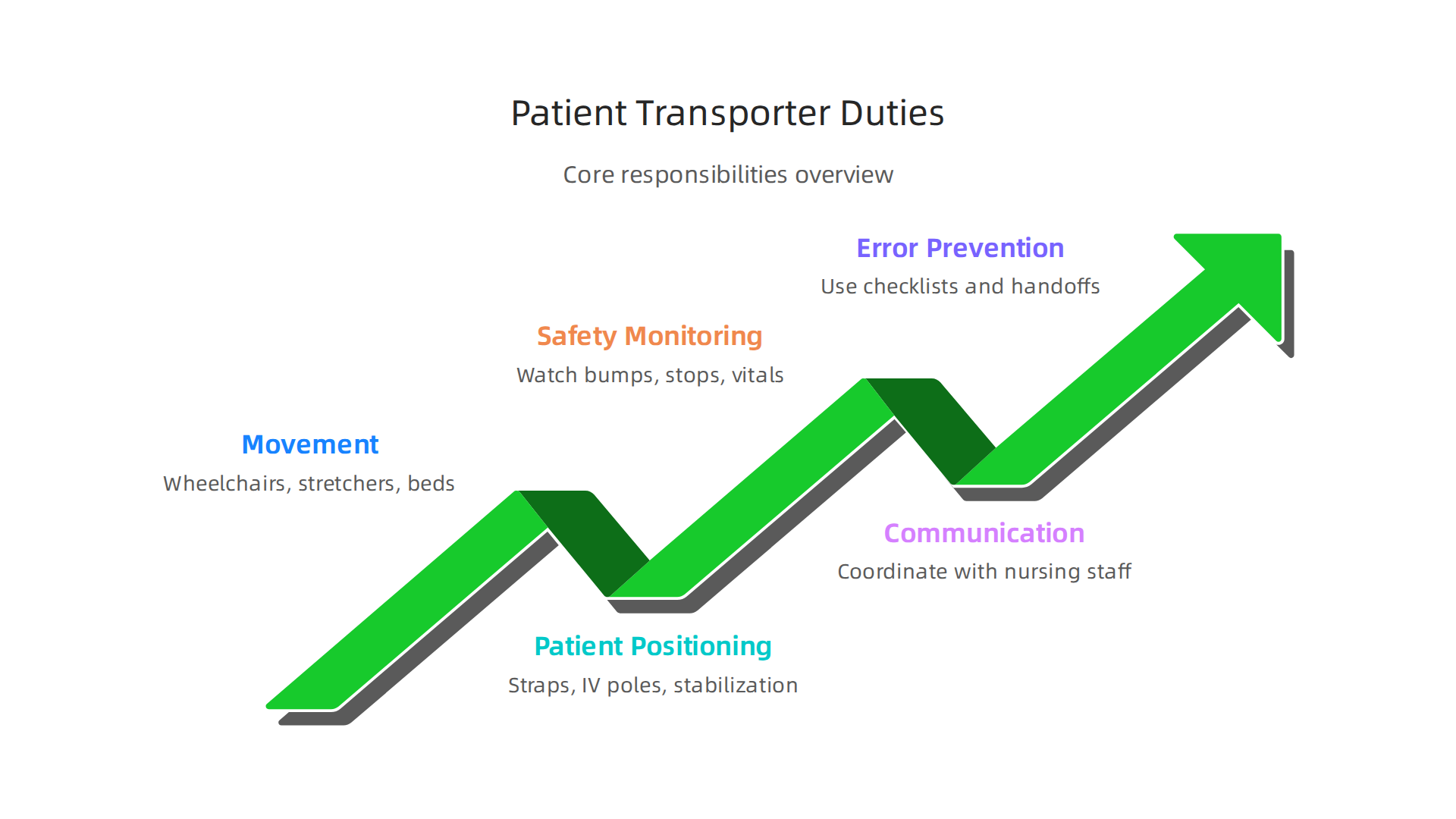
You might think a patient transporter just pushes a wheelchair down a hallway. But the job is a lot more than that. Every day, transporters help people move safely between departments. They use wheelchairs, stretchers, and hospital beds to get patients from their room to imaging, surgery, therapy, or the discharge area.
But the real skill is in the details. Transporters must position patients correctly on the stretcher or bed. They secure safety straps, adjust IV poles, and watch for bumps or sudden stops. They also help patients transfer from a bed to a wheelchair or back again. This requires steady hands and a calm voice. A patient who feels nervous or dizzy needs someone they can trust.
Safety is the top priority here. Hospitals use systems to prevent errors during these moves. For example, the Agency for Healthcare Research and Quality supports Patient Safety Learning Laboratories that study how to improve clinical processes like patient transport.
Using checklists and clear handoffs between staff reduces the risk of falls or equipment problems.
Transporters also communicate constantly with nursing staff. They check in before a move, report any changes in a patient’s condition, and update transport logs so everyone knows where each patient is. This may seem small, but it keeps the whole hospital running on time.
So the role is part mover, part safety checker, and part communicator.
It is a hands on job that matters.
If you want to start a healthcare career, this is a great entry point. And just like sales professionals use career guides to find their next role, you can learn from similar resources. Check out how a careers advisor helps you land sales jobs faster and apply that same smart thinking to your healthcare job search.
Essential Skills and Qualities for Patient Transporters
So what does it take to succeed in patient transporter jobs? You might think it is all about being strong enough to push a stretcher. And yes, physical stamina matters. You will be on your feet for most of your shift. You will push wheelchairs, help patients get on and off beds, and navigate tight hallways. But the real difference comes from a mix of soft skills and attention to detail.
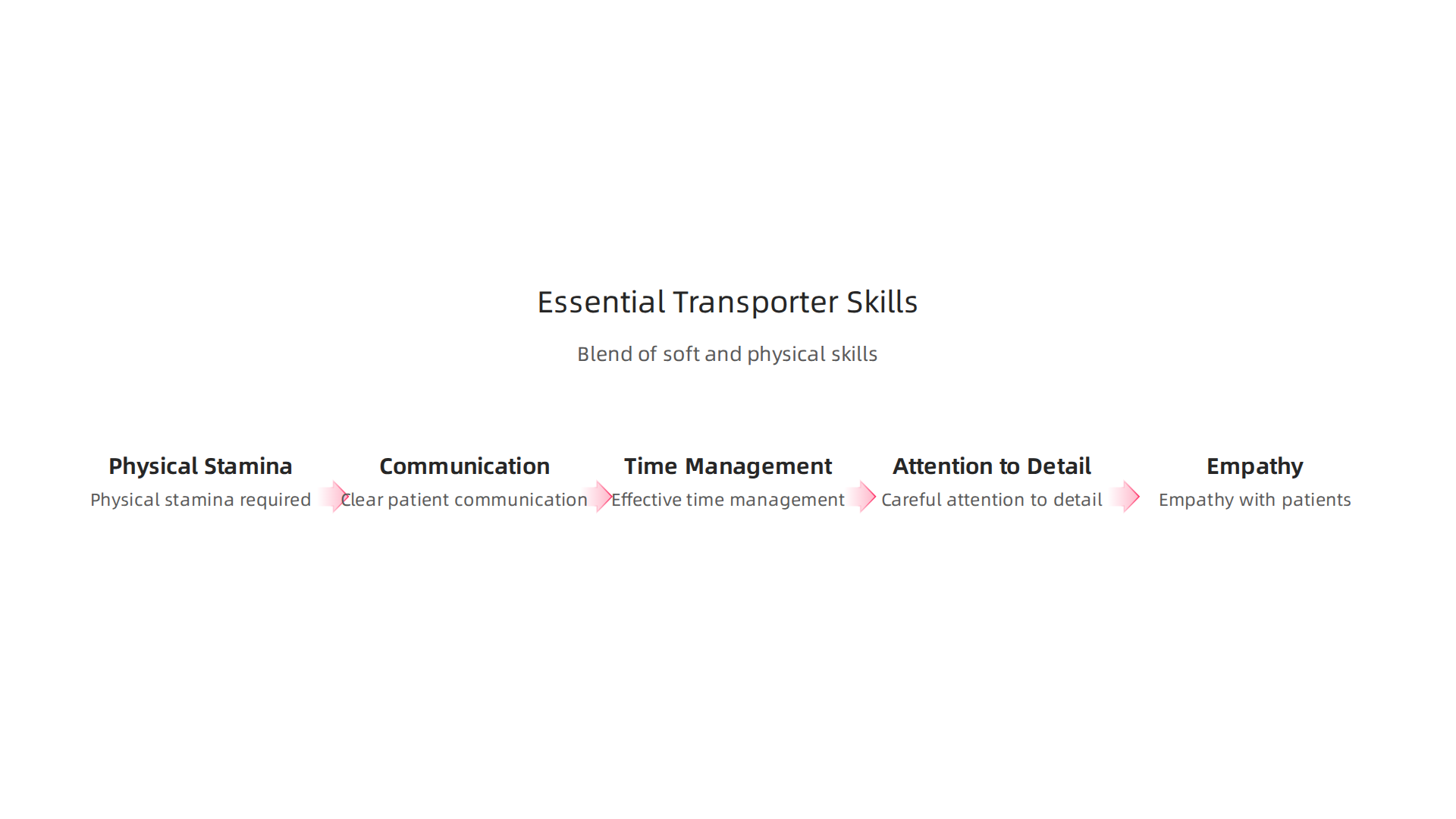
Communication is huge. You talk to patients who might be scared or in pain.

You explain what you are doing and ask if they are comfortable. You also speak with nurses, doctors, and other staff to make sure everyone knows the plan. Strong customer service skills turn a simple transport into a positive experience. A friendly word can calm someone down.
Time management and attention to detail go hand in hand. You might have three transport requests at once. You need to decide who goes first based on urgency. You also need to check patient ID bands, watch for changes in breathing or alertness, and follow safety steps every time. One small slip could cause a fall or injury. That is why the best transporters are always focused.
Empathy matters just as much. A patient waiting for a scan may feel nervous. Another who just had surgery might be dizzy. You need to read their emotions and adjust your pace and tone. Being kind takes no extra time but means everything.
How do you build these skills? Most employers ask for a high school diploma or GED. Beyond that, certifications like Basic Life Support (BLS) or a Patient Care Technician (PCT) credential help you stand out. According to Zippia, certifications such as Medical Assistant and Patient Care Technician are among the best for patients transporters.

You can also take a focused program through an online course like the Healthcare Patient Transporter Certificate offered by Penn Foster to learn the ropes.
Many hospitals offer full time jobs right now and are hiring immediately for these roles. If you want to explore similar opportunities in healthcare, check out this guide on Froedtert careers to see how different hospital roles fit together.
Bottom line: if you bring physical stamina, clear communication, and a caring attitude, you already have the core ingredients for patient transporter jobs. The rest you can learn on the job or through a short training program.
Certification and Training Requirements
You already know the core skills needed for patient transporter jobs. Now let’s talk about the training and certifications that can help you get hired. The good news is you don’t need years of school. Most employers only ask for a high school diploma or GED, according to Indeed’s career guide.
From there, you have two main paths: learn on the job or earn a formal certificate.
On-the-job training is common. Many hospitals teach you their procedures, equipment use, and safety steps during your first weeks. You work alongside an experienced transporter who shows you the ropes. This is a great option if you want to start earning quickly. You can often find full-time jobs with jobs hiring immediately that include this training.
Formal certification programs give you a head start. They teach you the same skills in a structured way, and you finish with a credential that stands out on a resume. Programs like the Healthcare Patient Transporter Certificate from Impact Training Online or the Patient Transporter Training from Penn Foster can be completed online in weeks. Some cost a few hundred dollars, but they prove you are ready to work.
Common certifications that employers look for include:
- Basic Life Support (BLS) – Covers CPR and emergency response. Many hospitals require it.
- CPR certification – Often the minimum for entry-level roles.
- Patient Care Technician (PCT) credential – This goes deeper into patient handling and is ranked among the best certifications for patient transporters, according to Zippia.
- Medical Assistant certification – While broader, it also boosts your chances.
How does certification help? In a competitive job market, a certification can tip the scales in your favor. You may qualify for higher‑paying positions or more responsibility. Some employers also offer a pay bump for certified transporters.
So whether you choose to learn on the job or earn a certificate first, both paths can lead to a stable career. If you want to see what roles are open right now and how hospital careers fit together, check out this guide on Froedtert careers for inside tips on the hiring process.
Patient Transporter Salary and Job Outlook
Now that you know how to get certified, you’re probably wondering: How much can you actually earn? And is this a stable career? Let’s break down the numbers so you can see if patient transporter jobs fit your financial goals.
How much does a patient transporter make?
The pay can vary a lot depending on where you live, the type of facility, and your experience level. Here’s what real salary data shows for 2026:
- Hourly range: Most patient transporters earn between $15 and $22 per hour. PayScale reports a national average of $16.01 per hour in 2026, while Indeed puts the average closer to $22.49 per hour for Patient Transporter employees. That gap comes down to location, employer, and job title.
- Annual salary: Salary.com calculates the average yearly pay at $37,372 (about $18 per hour). Glassdoor shows a higher figure near $40,492 per year when including tips and bonuses.
- Entry-level vs. experienced: Beginners often start on the lower end, but with a year or two of experience, you can move up. Zippia notes the overall average salary for patient transporters sits around $29,476, which reflects many entry-level roles.
What affects your pay?
Your earning power isn’t fixed. These factors make a big difference:
- Location: Big cities and states with a higher cost of living usually pay more. For example, in Atlanta, Georgia, the average hourly pay drops to $15.02 in 2026, according to PayScale. But hospitals in New York or California may offer $20-plus per hour.
- Facility type: Large teaching hospitals or specialized medical centers often pay better than small clinics or nursing homes.
- Certifications: Remember that BLS certification or PCT credential we talked about? Those can unlock a pay bump or qualify you for better shifts.
- Shift differentials: Working nights, weekends, or holidays often adds a few dollars per hour.
Job outlook: Is demand strong?
Yes. Patient transporter jobs are in demand. Zippia confirms that the occupation is growing steadily as hospitals expand and more patients need transport within facilities. With an aging population, the need for healthcare support roles like this will keep rising through 2026 and beyond.
Think of it this way: hospitals always need people to move patients safely, especially during busy periods. This is a stable role that isn’t going away.
And because the work is essential, you often can find full time jobs and jobs hiring immediately with minimal waiting. If you want to verify salary numbers before applying, learning to spot fake employer data can help. Check out this guide on how to spot fake Glassdoor reviews to make sure you’re getting honest pay information.
The bottom line: patient transporter jobs offer a reliable income with room to grow, especially if you earn certifications and choose the right location.

In the next section, we’ll cover how to land one of these roles fast.
How to Find Patient Transporter Jobs
You know the pay is decent and the demand is real. Now you just need to find an opening that fits. Here’s how to find patient transporter jobs fast.
1. Use the right job boards
Start with the big general platforms. Indeed lists thousands of patient transporter roles. You can filter by full time jobs, location, and pay range. Also check LinkedIn, Monster, and Glassdoor for jobs hiring immediately.

Don’t stop there. Healthcare specific job boards like Health eCareers and HospitalCareers.com focus on medical support roles. Many hospitals also post directly on their own career pages. Make a list of hospitals near you and check their sites weekly.
2. Network the smart way
Many patient transporter jobs never get posted publicly. That’s where networking helps.
- Contact hospital HR departments directly. Even if no opening is listed, they may keep your resume on file.
- Sign up with healthcare staffing agencies. They place people in temporary and permanent roles quickly.
- Talk to current transporters or nurses you know. A referral can get your resume to the top of the pile.
If you need extra guidance on the job search process, a careers advisor can help you navigate applications and interviews faster.
3. Tailor your application to stand out
Hospitals get tons of applications. Make yours impossible to ignore.
- Use the exact job title from the posting in your resume. If it says “Patient Transporter,” don’t write “Hospital Aide.”
- Highlight skills that matter: customer service, physical stamina, ability to follow safety protocols.
- List your certifications clearly. BLS and CPR training are big pluses.
- Use a curated job search method to target only the best openings instead of applying everywhere.
4. Search with the right keywords
When you search online, try these terms to find more results:
- Patient transporter jobs
- PCT jobs (patient care transport)
- Hospital transport jobs
- Medical transporter
- Jobs hiring immediately near me
According to Zippia, patient transporter jobs are in demand and growing. With the right strategy, you can land one quickly.
Next, we’ll walk through what to expect on your first day and how to succeed in the role.
Career Advancement Opportunities
Here’s the thing about landing one of those patient transporter jobs. It’s rarely a dead end. In fact, many healthcare workers start right where you are now, moving patients from room to room, before climbing into higher paying, more specialized roles.
Your time as a transporter builds skills that hospitals love. You learn how to talk to patients under stress. You get comfortable with medical equipment and safety protocols. You see how different departments work together. That real world experience is gold when you apply for your next role.
Common next roles for transporters
Many transporters move into direct patient care jobs after a short training period.
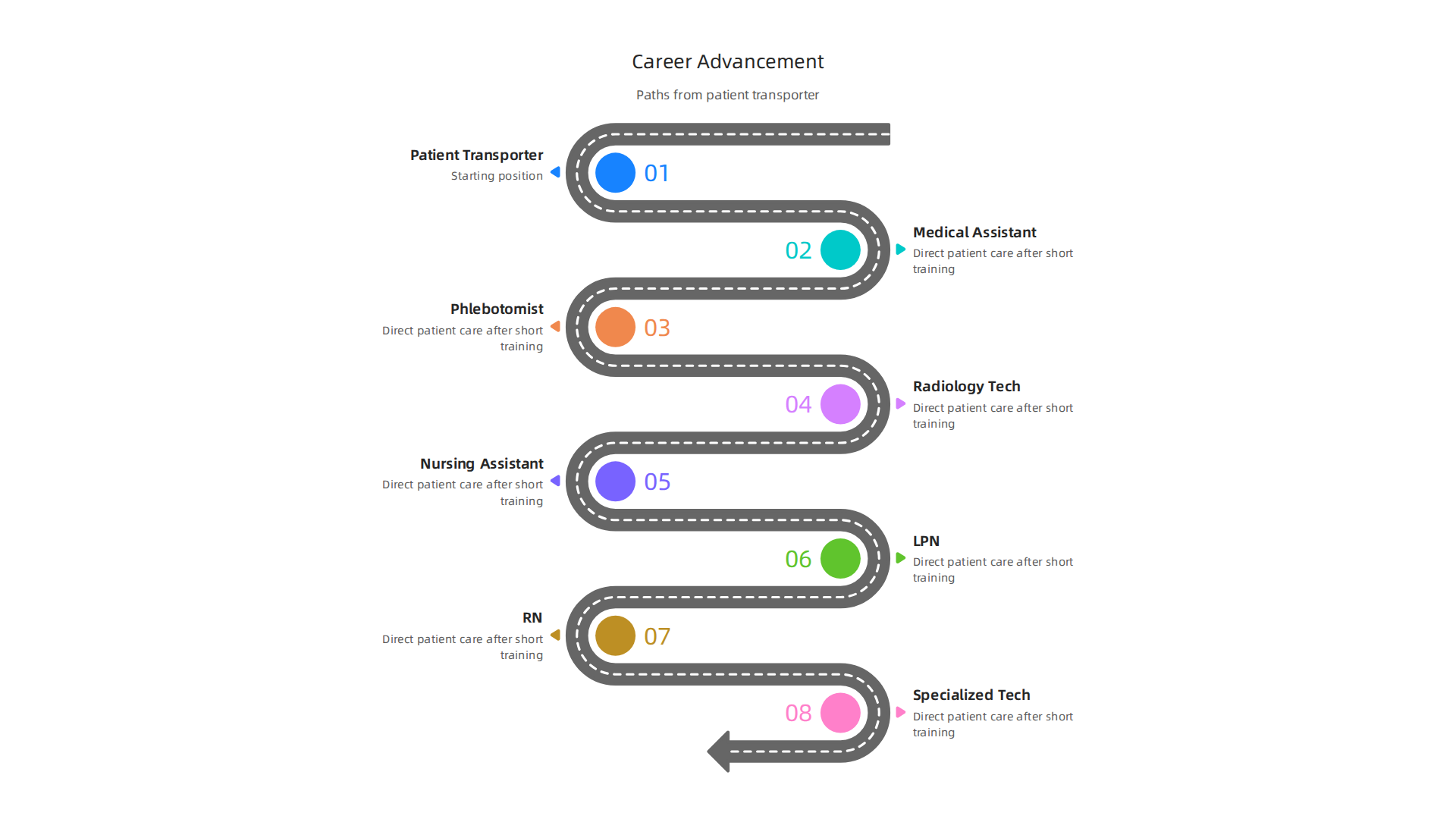
- Medical assistant. You already know the hospital layout and patient flow. Add a certification, and you can step into this role quickly.
- Phlebotomist. If you enjoyed the hands on side of transport, drawing blood is a natural next step. Training takes just a few months.
- Radiology tech. This one requires more school but pays significantly more. Your familiarity with radiology departments gives you a head start.
- Nursing assistant. Many hospitals will train you on the job. Your patient handling skills transfer directly.
We see these same patterns in job listings across the country. Hospitals in Tennessee, Maryland, and Indiana all list transporter experience as a foundation for nursing assistant and medical assistant roles.
Education pathways that pay off
If you want to go further, consider these options:
- LPN (Licensed Practical Nurse). One year of training. Much higher pay. Your hospital may even offer tuition help.
- RN (Registered Nurse). Two to four years of school. This is one of the most stable careers in healthcare.
- Specialized technician. Think surgical tech, MRI tech, or ultrasound tech. Programs range from one to two years.
A careers advisor can help you map out which path fits your life and budget best.
Skills you already have
Don’t sell yourself short. As a transporter, you’ve already built:
- Communication skills. Talking to scared or confused patients takes patience.
- Physical stamina. You’re on your feet and moving all shift.
- Teamwork. You work with nurses, techs, and doctors every day.
- Time management. Multiple transport requests at once? You learn to prioritize fast.
These transferable skills make you a strong candidate for almost any entry level healthcare role. Your first patient transporter jobs are just the beginning of a much bigger career journey.
Crafting a Winning Resume for Patient Transporter Jobs
Your resume is your ticket to getting noticed. And here’s the good news. You don’t need a long work history to make it shine. Hiring managers care more about your skills, your attitude, and your ability to stay calm under pressure.
Let’s build a resume that actually gets you called back.
The key sections you need
Most hospitals and health systems use applicant tracking systems to scan resumes first. That means your resume needs the right sections in the right order.
- Summary. A short, two to three sentence opener that says who you are and what you offer. Example: "Compassionate patient transporter with strong customer service background and hands on experience moving patients safely throughout the hospital."
- Skills. List both hard and soft skills. Think patient handling, equipment operation, communication, teamwork, and time management.
- Experience. Even if you haven’t worked as a transporter yet, include any customer service, retail, or caregiving roles. Hospitals love experience with people.
- Certifications. CPR, first aid, and any safety training you have. If you don’t have any yet, mention that you are willing to get them.
For more tips on structuring your resume, check out this guide to landing a job in a competitive market. The same principles apply to healthcare.
Action verbs and measurable achievements
This is where many job seekers fall short. Instead of saying "I helped transport patients," try something stronger.
Use action verbs like:
- Coordinated
- Assisted
- Safely transported
- Managed
- Communicated
Now add numbers. Numbers catch attention.
- "Safely transported 15+ patients per shift across multiple departments."
- "Reduced average transport wait time by 20% through better route planning."
- "Communicated patient status updates to nursing staff for 30+ patients daily."
Even if you are just starting out, you can measure things. Think about speed, volume, or accuracy.
Common resume mistakes to avoid
Let’s be honest. Many resumes get tossed for simple reasons.
- Typos and bad formatting. Your resume represents your attention to detail. A fast typo can cost you the job.
- Being too vague. "Good communication skills" means nothing. Say "Explained transport procedures to anxious patients clearly."
- Ignoring the job description. Every hospital is different. Tailor your resume to each opening you apply for.
- Leaving out keywords. Many hospitals search for specific terms like "patient transporter," "safe patient handling," or "hospital volunteer." Use them naturally.
If you are looking for full time jobs or pct jobs, make sure your resume highlights relevant experience for those roles too.
Where to find jobs hiring immediately
Once your resume is ready, you need to get it in front of hiring managers. Cities like Las Vegas, Louisville, and Nashville all have strong demand for transporters. For example, there are often dozens of patient transport jobs available in Tennessee. The same goes for Indiana and Maryland.
And remember, a strong resume is just one piece of the puzzle. If you want help mapping out your next move, talking to a careers advisor can make the whole process faster and less stressful.
You have the skills. Now let your resume prove it.
Work Environment and Safety Considerations
Now you know how to build a strong resume. But what happens once you land the job? Let’s talk about where you will work and how to stay safe on the job.
Where patient transporters work
Most patient transporter jobs are in three main settings.
- Hospitals. This is the most common place. You will move patients between rooms, labs, surgery, and imaging centers. Large hospitals can have hundreds of beds and many floors. You will be on your feet a lot.
- Clinics. Smaller than hospitals but still busy. You might transport patients from the waiting room to exam rooms or to different specialists in the same building.
- Long term care facilities. Nursing homes and rehab centers also need transporters. The pace is often slower here, but the work is just as important.
Every setting has its own flow. But one thing stays the same. Safety comes first.
Physical risks and how to prevent injury
This job is physical. You will push beds, wheelchairs, and stretchers all day. You will help patients move from beds to chairs and back. Over time, this can strain your back, shoulders, and knees.
The good news is that hospitals care about your safety too. Many use what is called a patient safety learning approach to study and improve their processes. The Agency for Healthcare Research and Quality supports programs that help hospitals design safer systems for both patients and workers.
Here are some simple injury prevention tips that work.
- Use your legs, not your back. Bend at the knees when lifting. Keep the weight close to your body.
- Ask for help. Never try to lift a heavy patient alone. Call a coworker or use a mechanical lift.
- Watch your footing. Hospital floors can be slippery. Wear non slip shoes and move slowly when needed.
- Take breaks. Your body needs rest. Rushing all day raises your risk of injury.
Infection control and proper equipment use
This is a big deal in healthcare. As a transporter, you touch beds, door handles, and patients all day. That means you can spread germs if you are not careful.
Follow these basic rules.
- Wash your hands. Before and after every transport. Use hand sanitizer if soap is not nearby.

- Clean equipment. Wipe down wheelchairs, stretchers, and bed rails between patients.
- Use gloves when needed. Some patients are in isolation. Your hospital will tell you when to wear gloves or a mask.
- Follow the hospital checklist. Many facilities use checklists to make sure nothing is missed. Studies show that checklists and error reporting systems help improve patient safety and cut down on mistakes.
Also, know your equipment. Each bed, wheelchair, and lift works a little differently. Take time to learn before you rush. Proper use keeps you and your patient safe.
Putting it all together
Whether you are looking for patient transporter jobs at a big hospital or a small clinic, safety is part of the job every single day. The work is rewarding, but it demands focus. If you want to learn more about building a career in healthcare, reading job search guides like this one on finding roles in competitive markets can give you extra confidence.
Stay smart. Stay safe. You have got this.
Summary
Patient transporters are the hands-on staff who move patients safely between rooms, imaging, surgery, and discharge, and this article explains why the role is a vital, entry-level gateway into healthcare. It covers daily duties—positioning patients, securing equipment, and communicating with clinical teams—along with the soft skills and physical stamina employers value most. You’ll learn the common training paths, from on-the-job orientation to short certificate programs and key credentials like BLS or CPR that boost hiring chances and pay. The guide breaks down current salary ranges, factors that affect earnings, and why demand remains steady, plus practical tactics to find jobs fast using the right job boards, networking, and targeted resumes. It also shows how to stay safe on the job with proper lifting, infection control, and equipment use, and outlines realistic career ladders into roles like medical assistant, phlebotomist, or nursing. After reading, you’ll know how to prepare a resume, where to look for openings, what to expect on day one, and how to turn a transporter job into long-term healthcare career growth.